Bedroom Staging: A Step-by-Step Guide Before Listing Photos
Bedroom staging means clearing personal items, editing furniture down to what supports the room's function, and arranging light, linens, and surfaces so the space reads as calm and spacious in photos and in person. It is done before a photographer arrives, and it applies to every bedroom in the home, not just the primary one.
Table of contents
- What does bedroom staging actually involve?
- How do you prepare a bedroom for staging photos?
- Should you stage every bedroom the same way?
- What do stagers and realtors actually check for?
- FAQ
What does bedroom staging actually involve?
Bedroom staging is the process of preparing a bedroom so that a camera and a walk-through visitor both read the room the same way: calm, functional, and easy to picture using. That means removing anything that signals daily life in a way that distracts, and keeping only what supports the idea of "bedroom."
This is different from decorating. Decorating is about personal taste. Staging is about reducing decisions for the viewer. A stager or realtor walking through with a checklist is usually looking at four things: what's on the floor, what's on the surfaces, what's on the walls, and how the light falls.
Most bedroom staging work happens before any photo is taken, because photos are permanent and get shared across multiple platforms. A room that looks fine to the eye in person can look cluttered or oddly proportioned once compressed into a single wide-angle photo, so this step deserves real attention rather than being rushed.
Next, walk the room slowly, the way a photographer would, standing in the doorway and scanning left to right. Note anything that catches your eye for the wrong reason: a cord across the floor, a stack of items on a nightstand, a mismatched hamper. Each of those is a small task, not a redesign.
Stagers who do this professionally for realtors typically produce a short written list per room before anything is touched. That list becomes the to-do sheet for the seller. If you are doing this yourself, the same approach works: write the list first, then act on it, rather than tidying room by room from memory.
If you want to see how a stager typically approaches this across an entire property, the Listing Prep Almanac walks through the same logic room by room.
How do you prepare a bedroom for staging photos?
The preparation sequence matters more than any single decorating choice. Doing steps out of order usually means redoing work.
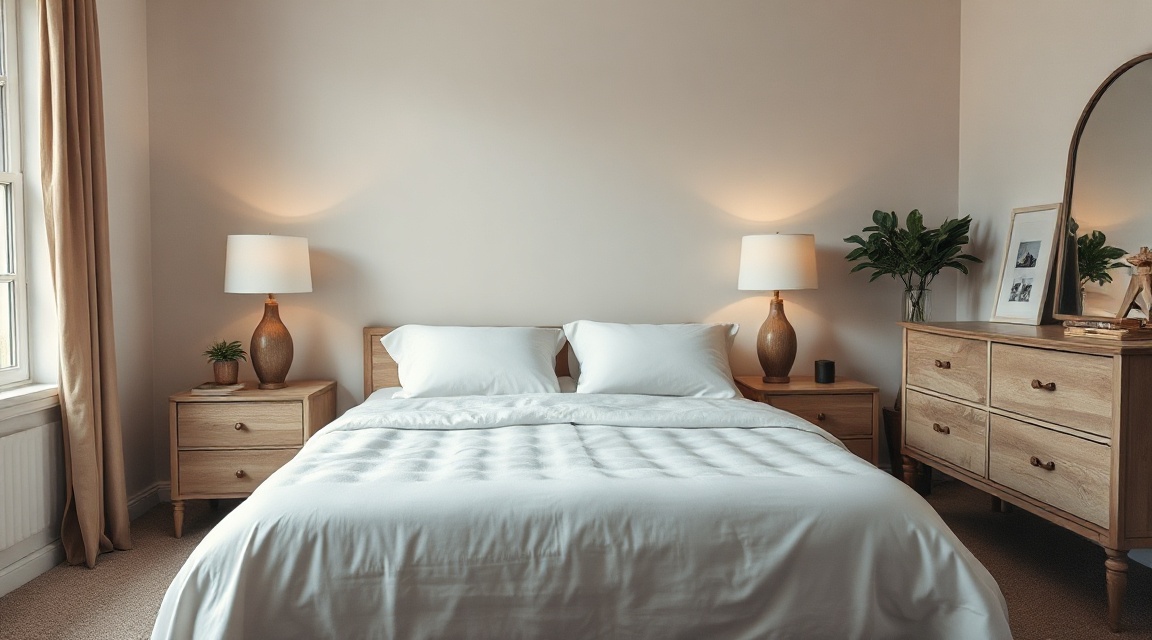
- Clear the floor first. Remove anything that is not furniture: shoes, bags, baskets, chargers, exercise equipment. An empty floor changes how large a room reads in a photo more than almost anything else.
- Edit the furniture down. A bedroom generally needs a bed, one or two nightstands, and one seating or storage piece. Extra furniture, even attractive furniture, makes a room look smaller and busier in wide shots.
- Clear every surface except one or two objects. Nightstands, dressers, and windowsills should hold almost nothing. A single lamp, a small tray, or one plant reads as intentional. Ten small items reads as clutter, however tidy each item is individually.
- Make the bed with flat, matching linens. Patterned or mismatched bedding photographs unevenly under artificial light. A simple duvet with two or three pillows in complementary tones tends to photograph the most consistently.
- Open the blinds and turn on every light source. Mixed lighting, some lamps on, some off, some curtains open, some closed, creates uneven color casts in photos. Consistency matters more than brightness.
- Remove personal photos and personal items from view. This lets a viewer picture their own life in the space rather than someone else's.
- Check closets if doors will be photographed open. A visibly overfull closet undercuts the sense of space the rest of the staging created.
Pro tip: Do the entire clearing pass across all bedrooms before you start arranging any single one. Working room to room in sequence, clear-then-arrange, clear-then-arrange, tends to leave items half-sorted in hallways for days. Clearing everything first, then styling each room in a second pass, finishes faster and looks more consistent across rooms.
Should you stage every bedroom the same way?
No. Different bedrooms serve different purposes for a viewer, and staging them identically can actually work against the listing. A primary bedroom, a smaller secondary bedroom, and a room currently used as an office or storage space each need a slightly different approach.
The table below compares common bedroom types and how staging priorities shift for each.
| Bedroom type | Main staging priority | Common mistake to avoid |
|---|---|---|
| Primary bedroom | Show clear floor space around the bed and a simple, cohesive palette | Overfilling with decorative pillows and throws that hide the bed's actual size |
| Secondary or guest bedroom | Keep it clearly identifiable as a bedroom, not a storage catch-all | Leaving boxes, exercise gear, or off-season items visible in the closet or corners |
| Home office or flex room | Decide in advance whether to stage it as a bedroom or as an office, and commit fully | Leaving it half-office, half-bedroom, which reads as unfinished to a viewer |
| Child's bedroom currently in use | Simplify toys and personal items without erasing that the room works as a bedroom | Removing so much personality that the room reads as empty rather than calm |
A flex room deserves a specific mention. If a spare room currently holds a treadmill, a desk, and a guest bed, decide before the photographer arrives whether it will be presented as a bedroom or as a workspace. Presenting it as both usually reads as unresolved in photos, since the eye cannot settle on the room's purpose.
If you are unsure how to make that call for a specific property, a local stager can usually answer it in a short walkthrough. You can find a home stager near you if you would rather have someone assess the rooms directly, or check listings for home stagers in Toronto, home stagers in Ottawa, or home stagers in Oshawa if you are in one of those markets.
What do stagers and realtors actually check for?
Professional stagers and realtors who prepare listings for a living tend to work from a repeatable checklist rather than judgment calls made room by room. That consistency is part of why the same report format gets used across many properties.
Common items on that checklist include: floor clearance, surface count per nightstand or dresser, whether linens are flat or heavily textured, whether curtains are open or closed, whether closet doors will be shown open or closed, and whether any cords, chargers, or laundry are visible from the doorway.
Realtors preparing a listing often ask a stager to produce this list before scheduling the photographer, because fixing a room after photos have already been taken means a second visit, a second edit, and a delay in getting the listing live. Producing the list first, then doing the work, then photographing once, is the more common sequence in practice.
If you want to compare how different service levels handle this step, from a full in-person consultation to a photo-based written report, compare staging options lays out the practical differences.
For general guidance on preparing a home for sale that goes beyond staging alone, the U.S. Department of Housing and Urban Development publishes consumer-facing resources on buying and selling a home, which covers some of the broader context around preparing a property for the market.
FAQ
Does bedroom staging mean buying new furniture? Not usually. Most bedroom staging works with furniture already in the home, edited down to fewer pieces and rearranged for clearer sightlines. Bringing in additional furniture is sometimes done for a primary bedroom that is otherwise empty or very sparse, but it is not the default approach for most bedrooms.
How long does bedroom staging take for one room? A single bedroom can usually be cleared and arranged in under an hour once the plan is written down. The planning step, deciding what stays, what moves, and what gets removed entirely, is what a written report speeds up, since it removes the back-and-forth of deciding room by room on the spot.
Do I need to stage a bedroom that is currently used as storage? Yes, if it will be shown to potential buyers as a bedroom in listing photos. A room shown as storage with no bed or clear bedroom function can be confusing in a floor plan, since the room's listed purpose and its photographed contents no longer match.
Key takeaways
| Point | Why it matters |
|---|---|
| Clear floors before anything else | Floor space affects how large a room reads in photos more than furniture choice |
| Edit surfaces down to one or two objects | Fewer objects photograph as intentional, more objects photograph as clutter |
| Match linens and lighting across rooms | Uneven bedding or mixed lighting creates inconsistency across a listing's photo set |
| Stage each bedroom type differently | A primary bedroom, guest room, and flex room each need a different priority list |
| Write the list before doing the work | A written room-by-room list avoids redoing tasks and speeds up the actual staging |
| Decide a flex room's identity in advance | A room presented as both office and bedroom tends to read as unresolved in photos |
Keep reading
For sellers
The home staging checklist, room by room
Every room in the house, in the order to do them: what to remove, what to rearrange, and what a photo actually notices.
For sellers
What to fix before selling your house (and what to skip)
The repairs buyers notice first, and the projects you should not start six weeks before listing.
For sellers
How to declutter before selling, without the panic
A calm order of operations for thinning out a house before listing: what goes first, where it goes, and how far is far enough.
Want this list built for your actual rooms?
Upload a few phone photos and the free Staging Snapshot starts the plan for your rooms. No account needed.